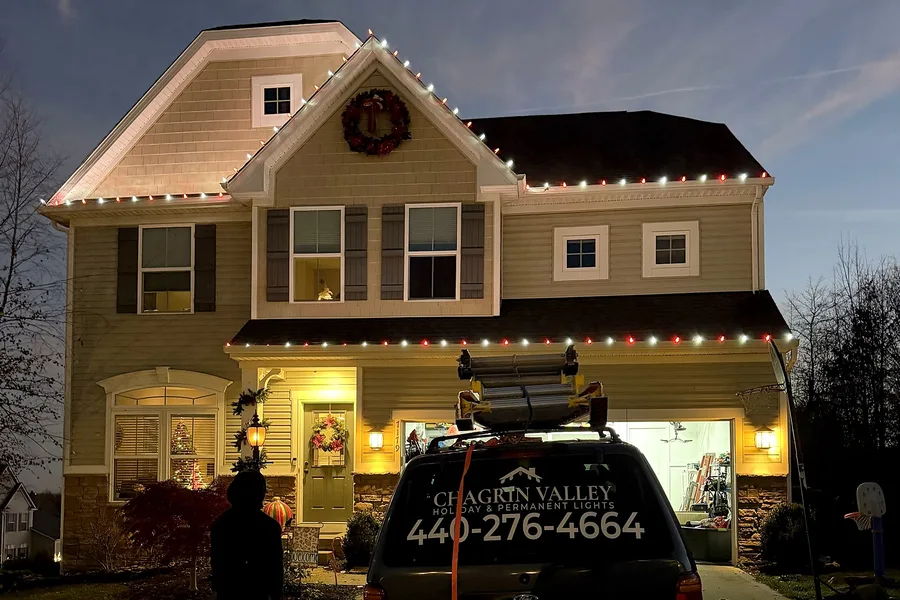
To start a Christmas light installation business, form an LLC, get general liability insurance, buy commercial C9 bulbs, wire and clips for your first few homes, set a job minimum, sell Good / Better / Best packages, and lease the lights so customers renew every year. We started Chagrin Valley Holiday & Permanent Lights in Northeast Ohio in 2026 this way and did over $25,000 in our first two months.
This guide walks through the whole thing in the order we'd do it again, with links to the exact gear and the deeper guides for each step.
1. Decide What You'll Sell
Most new installers start with seasonal lighting: commercial C9 bulbs on custom-cut wire, clipped to the gutters and roof edges, installed in the fall and taken down after the holidays. It's the easiest to learn, the cheapest to start and it renews every year.
Permanent lighting (track lights mounted under the roof edge that stay up year-round) is a bigger ticket, but it takes more tools, more install skill and longer material lead times. We sell both, with permanent as the top option. If you're brand new, start seasonal and add permanent once you've done a season. Our permanent vs. seasonal guide breaks down the money side of each.
2. Set Up The Business The Right Way
- Form an LLC and get an EIN so you can sign contracts and keep business money separate.
- Open a business bank account and take payments by card. We use a deposit link at signing and keep the card on file for the balance and renewals.
- Write a real agreement. Ours covers the package, the term, the deposit, renewals and what happens if weather pushes a date.
3. Get Insured Before You Climb
General liability is the minimum for ladder and roof work, and HOAs and businesses will ask for a certificate before you start. Read our insurance guide for light installers before your first job, especially if you'll have help on the crew.
4. Buy Gear For Your First Few Homes, Not Your Whole Season
You can start for about $520 in supplies and tools if you already own a ladder that reaches the roof. That covers roughly 100 ft of roofline plus the testers and measuring tools to quote accurately. Because each home's lights are custom cut and stay with that home, you buy more bulbs, wire and clips as you book jobs.
The core list: C9 bulbs, SPT-1 wire and vampire plugs, gutter clips and shingle tabs, timers, GFCI protection and cords, a measuring wheel and a ladder setup that reaches safely. Our $500, $1,500 and $3,000 starter packs list exactly what to get, and the startup cost guide explains each budget.
5. Price From The Measurement, Not A Guess
Measure every roofline on the site walk and build the price from the linear feet, your material cost and your labor. Set a minimum so small jobs are still worth the trip. Ours is $1,000 per season. Then present three packages at clearly different price points. The full method is in our pricing guide.
6. Lease The Lights And Sell Multi-Season Terms
This is the part most new installers miss. We don't sell the lights. Customers lease them for 1, 3 or 5 seasons, and the agreement renews automatically with a text before each renewal charge. Year one carries the material cost. Every renewal after that reuses the same custom-cut lights, so it's mostly labor and profit.
We don't discount longer terms. Multi-season customers get perks instead: their price is locked for the full term, they get first pick of install and takedown dates, and bulb upgrades and replacements are free every season.
7. Get Your First Customers
Our first customers came from existing customers of another business we run, referrals from other home service businesses like pressure washing companies, local Facebook groups and Google. We break down every channel in how to get your first 10 customers.
8. Run The Site Walk Like A Pro
Walk the house, measure, find the outlets and agree on exactly what gets lit. Standard is the gutter lines and rakes. Ridges are optional. We leave out any section that would need a lift or is too steep for a ladder unless the customer specifically asks, and then it's quoted separately.
Two rules saved us a lot of headaches. First, no scope creep: install exactly the approved package and quote any additions separately. Second, don't promise an install date before your materials ship. Give dates once your supplier gives you a ship date.
9. Install, Service And Take Down
First installs start in October here, takedowns run into January weather permitting, and there's no hard cutoff on late installs. Each install includes a timer and one in-season service call, and we answer service requests within 48 hours. After takedown, the lights go into labeled bins in climate-controlled storage so next season's install is fast. See our storage gear.
10. Plan For Growth
A two-person crew can realistically handle 30 to 50 homes in a season. Past that, you're hiring, training and managing. Get the systems in place early: one place for leads, quotes, schedules and crew job sheets.
Frequently Asked Questions
Is a Christmas light installation business profitable?
It can be, mainly because of renewals. When you lease the lights and sell multi-season agreements, year one carries the material cost and every renewal reuses the same custom-cut lights, so later seasons are mostly labor. We did over $25,000 in our first two months.
Do I need a license to install Christmas lights?
Requirements vary by state and city. Most installers need a registered business and general liability insurance at minimum, and some areas require a local business or contractor registration. Check your state and city before your first job.
When should I start marketing?
Homeowners start searching in late summer and early fall, and the best install dates fill first. Start taking bookings in August or September so you can order materials and schedule October installs.
Can I run a lighting business without climbing roofs myself?
Yes. Many owners sell, measure and design, and use a trained crew or insured subcontractors for installs. Put the arrangement in a written agreement and make sure everyone on the roof carries proper coverage.
Get The Free Startup Kit
The checklist, what to buy first, a pricing worksheet, how to land your first 10 customers and a first-season timeline.
Send Me The KitWant The Business Side Done For You?
Our Launch Bundle covers LLC setup, a brand kit and a website built to get you booked. $2,997.
See The Launch Bundle